
Remnant vegetation in the reserve consists of Manna Gum and Messmate Forest with Blackwood, Black Wattle and a groundlayer containing Bracken and Common Tussock-grass in Dead man's Gully. A more open Manna Gum and Drooping Sheoak Woodland albeit with the many of the same associated understorey species occurred on
more exposed areas. The base of the crater contains Bracken and Common Tussock-grass, but woody species are
confined to the crater walls.
There are two small scoria outcrops present. The outcrop above the crater on the eastern side has Tree Violet
with native Pelargonium and a range of other smaller forbs. The outcrop on the west side above the crater
contains Blushing Bindweed, although only single specimens were noted.
There are further areas with Bracken and Common Tussock-grass. These are likely to have previously also
contained the Scoria Forest. The more exposed aspects (northern and western) still have a good cover of native grass. Spear and Wallaby grasses are present. One specimen of Pussy Tails was recorded. These sites would have contained a Drooping Sheoak Silver Banksia woodland with Black Wattle, Sweet Bursaria and Tree Violet.
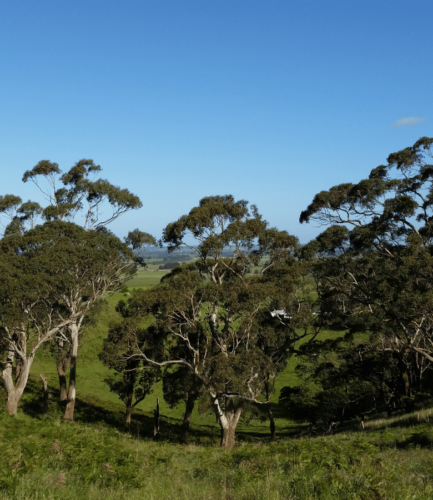
Important remnants of the Scoria Woodland community occur on Morack Street although there are extensive plantings of exotic species present as well. From the field survey, study of other scoria cones and the vegetation model, it is thought that the reserve previously contained four plant communities. From the model these are recorded as Floristic Map Units or FMUs.These are a finer scale classification than Ecological Vegetetation Classes (EVCs) which is necessary to guide revegetation and management at a local scale. The FMUs are summarised below with the most appropriate EVC given in brackets.
Scoria Cone Forest (EVC 23 Herb-rich Foothill Forest)
Scoria Cone Woodland (intermediate between EVC 23 and 894)
Scoria Cone Savannah(EVC 894 Scoria Cone Woodland)
Scoria Crater Rockland (no relevant EVC)