
During a walk up the Mount in the morning you are almost certain to see Honeyeaters (including Red Wattlebirds, White-plumed and New Holland Honeyeaters), Thornbills, Red-browed Finches, Willie Wagtails and Grey Fantails. You might hear the melodic songs of the Grey Shrike-thrush in the vegetation which flanks the first part of the track. Introduced species including Sparrows, Goldfinches, Starlings and Blackbirds will invariably make an appearance around here too. Depending upon the time of year you might come across Silvereyes, Superb Fairy-wrens (also known as Blue Wrens), Pardalotes, and if you’re lucky a Kookaburra, Sacred Kingfisher, Cuckoo or some other migrant.
As you enter the open paddocks Magpies are present. You will notice the absence of smaller birds, except for two; the Eurasian Skylark (Alauda arvensis) an introduced species from Britan which lives in farmland, and the Australian Pipit (Anthus Australia). The Pipit has a pale eyebrow stripe, the Skylark a prominent crest. Pipits are more likely to be seen moving on the ground foraging in search of food. On a clear day from the top of the Mount you can hear the Pipits. Check the fence posts, upper branches of dead Blackwoods in the crater and scan the slopes for our little friends. You are more likely to hear Skylarks singing or see them flying high above.
Little Ravens, known popularly as crows are visible across the paddocks and crater.
The Pied Currawong, with its distinctive call, can be heard from the direction of Glenormiston.
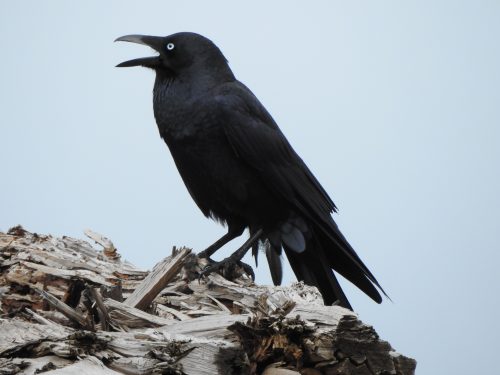
Little Raven
The Blackwoods in the crater house quite a few birds though not a large range. There are usually plenty of Thornbill and Grey Fantails, other small species come and go. Black-faced Cuckoo-shrikes feed here while passing through. The number and range of birds seen on the Mount varies greatly depending on the time of year. You will always see something, but there are times when it can be very quiet.
Bird species at the Mount are low these days. Which is understandable considering the proportion of the area that is devoid of trees and shrubs, which birds rely upon for food, nesting and cover. Another important factor is the shortage of 100 plus year-old eucalyptus. Many species of birds (as well as mammals and even some reptiles and insects) rely on tree hollows for nesting, and as a rule, hollows only develop in trees that are at least 100 years old.
It wasn’t always like this. Up until the time of European settlement there was a healthy cover of trees and shrubs on the Mount. Two large marshes were located just south, the Pejark Marsh and the Coorecurt Marsh. Huge number of waterbirds inhabited the marshes before they were drained. Brolgas, bitterns and magpie geese were among the waterbirds that once populated the nearby Pejark Marsh in large numbers.
Emus once wandered over Mount Noorat and the surrounding plains. Niel Black commented that, “Cangaroos (sic) and emus are as common on it as crows in a rookery at home…” (Niel Black’s Journal 1839-40, 4 Jan 1840 entry).
A letter written by Captain Fyans on 17 August 1853 shows the changes that had taken place. “Emus and kangaroos on our arrival were plentiful in all parts of the district; also the bustards in large flocks of from ten to twenty of forty or perhaps more. The bustards now are scarce, and only met with in distant places. The kangaroos and emu are nearly extinct in the district; the country is almost void of game”. (Middleton, 1984, p55)
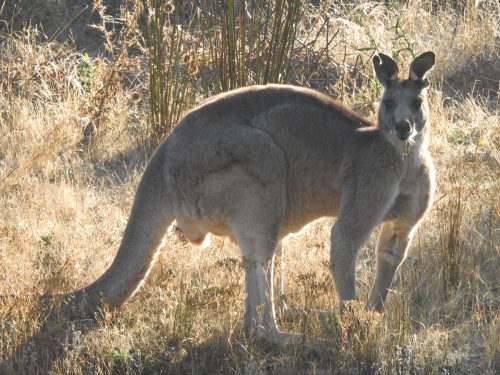
Eastern Grey Kangaroo
Raptors
We are extremely fortunate to still be able to see Wedge Tailed-eagles soaring on the thermals over the Mount.
Wedge-tailed Eagles, Brown Goshawks, Collared Sparrowhawks, Brown & Peregrine Falcons and Whistling Kites all patrol the paddocks and the peaks at different times of the day and year. Their numbers have fluctuated over the years depending on food availability and persecution by settlers.
Wedge-tailed Eagles were referred to as ‘eagle-hawks’ in the country districts. This did not do them justice. Its name Aquila audax – the bold eagle, describes its character which it quite lives up to.
James Bonwick, writing in 1857 of his visit to Glenormiston and Mount Noorat stated, “In the forest and stony country there are other varmint which trouble the settler besides kangaroos and fruit-eating opossums. Eagle-hawks and wild dogs are very mischievous to the flocks; lambs are the favourite objects of attack. The gun is insufficient, and poison is employed to destroy them…” He went on to say that Mr Roadknight informed him that in one day after laying poison he found the bodies of “four dozen … eagle-hawks”. (1858, p.38)
Bird species are numerous; falcons, hawks, kites and kestrels search the surrounding paddocks for rats and mice. At the highest point of the Mount, you can expect to see plenty of raptor action. Nankeen Kestrels and Black-shouldered Kites follow the food around and are most active at times when the number of rats and mice in paddocks are high. According to Middleton, Black-shouldered Kites have been the most successful since European settlement, with their numbers increasing.
Sources indicate that birds of prey inhabited the trees on Mount Noorat and skies overhead well before the arrival of Europeans. Initially it’s likely that the new settlers had little impact on their lives, but once stocking rates increased, the kangaroos were hunted to extinction, and the crash in the population of most of the smaller mammals occurred they, and other raptors would have been on the lookout for new food sources. Their options were further reduced with the draining of the marshes which resulted in far fewer waterbirds in the area.
-
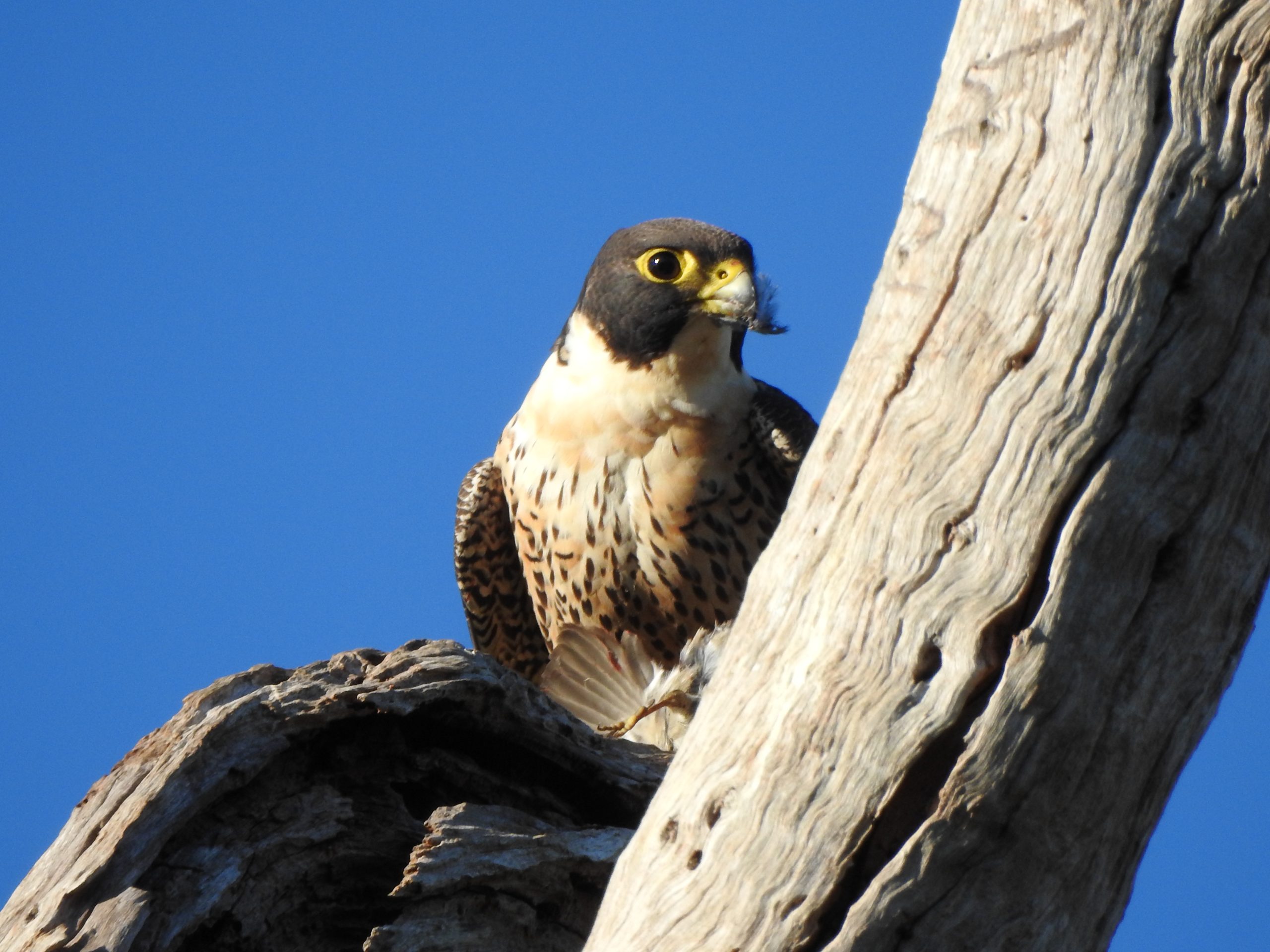
- Peregrine Falcon
-

- Wedged Tailed Eagle
-

- Black Shoulder Kite
Owls
Barn Owls, known as ‘Delicate Owls’ by settlers, Southern Boobooks (also known as Mopokes or Brown Owls) lived in the area when the habitat was still intact. It is highly unlikely that any live on Mount Noorat today. Before the old trees were cut down on the Mount in the 1840s it may even have been home of the rare Powerful Owl and the equally rare Barking Owl, which are found only in forest areas.
Parrots
Sulphur-crested Cockatoos, Galahs, Long-billed Corellas frequent Deadman’s Gully, utilising the tree hollows for nesting and rearing their young.
A large flock of Yellow-tailed black-cockatoos can be seen when they visit in autumn and sometimes spring to feast on pine nuts. Cockatoos have always been a feature of Mount Noorat and in the surrounding district. According to Frank Smith in1905 Sulphur-crested Cockatoos nested in large numbers ‘in the volcanic country” from Hamilton to Colac.
Yellow-tailed Black Cockatoos also lived on and around Mount Noorat in pre-European times. Unfortunately, they no longer nest on the Mount (or its vicinity). The Gang Gang was likely to have lived at Mount Noorat and in the district before it was cleared. Like the Yellow-tailed Black-cockatoo they only nest in the forests.
Crimson Rosellas, like most parrots still visit the local area (including the Mount) in the autumn and spring. Red-rumped Parrots (commonly referred to as Grass Parrots) are the familiar species of parrot which still breeds in the local district today, but they tend to nest in the old Red Gums along Mount Emu Creek, and rarely venture to Mount Noorat. This is probably due to the number of raptors up there, and the shortage of tree cover and food.
-
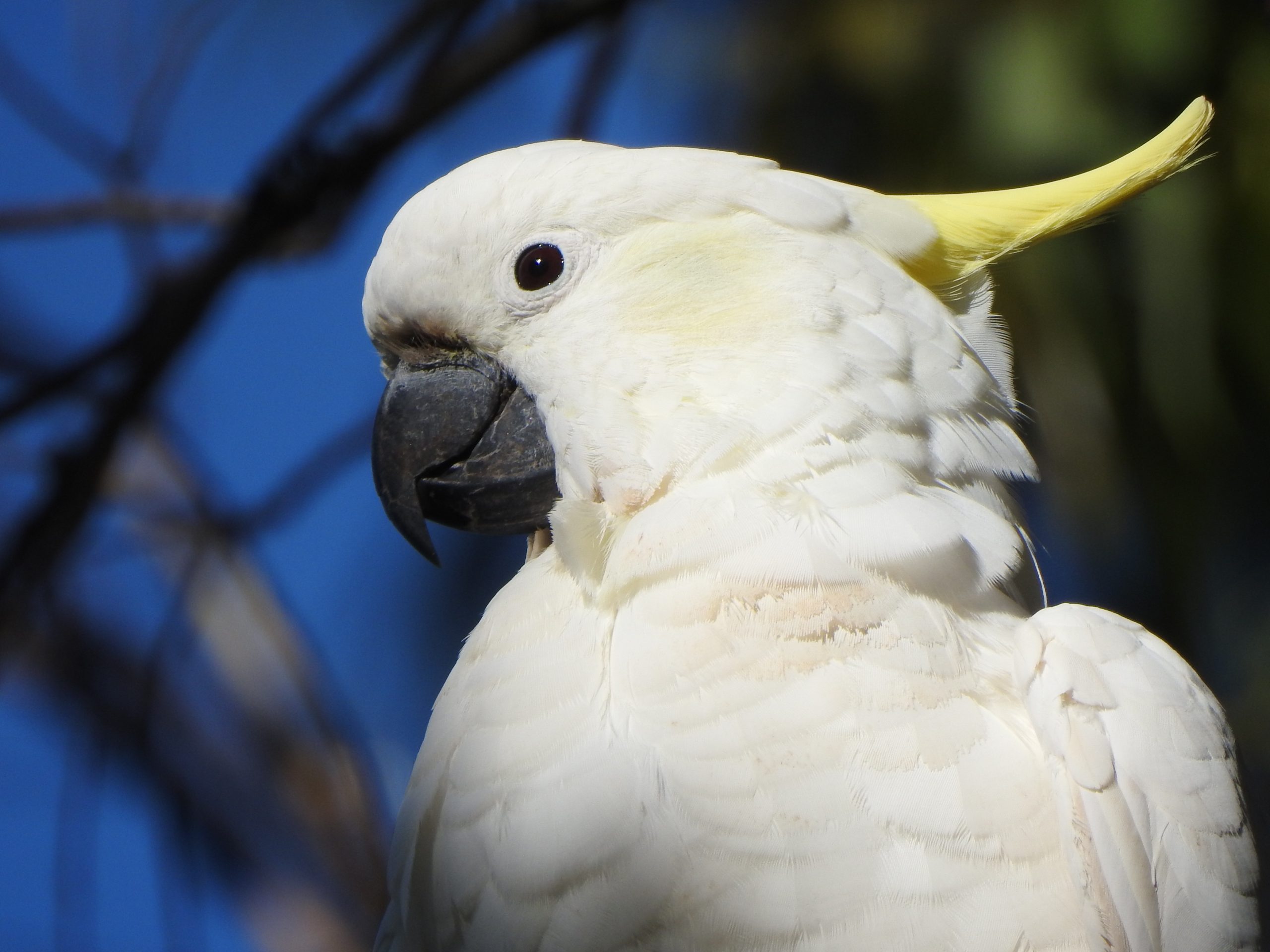
- Sulphur Crested Cockatoo
-
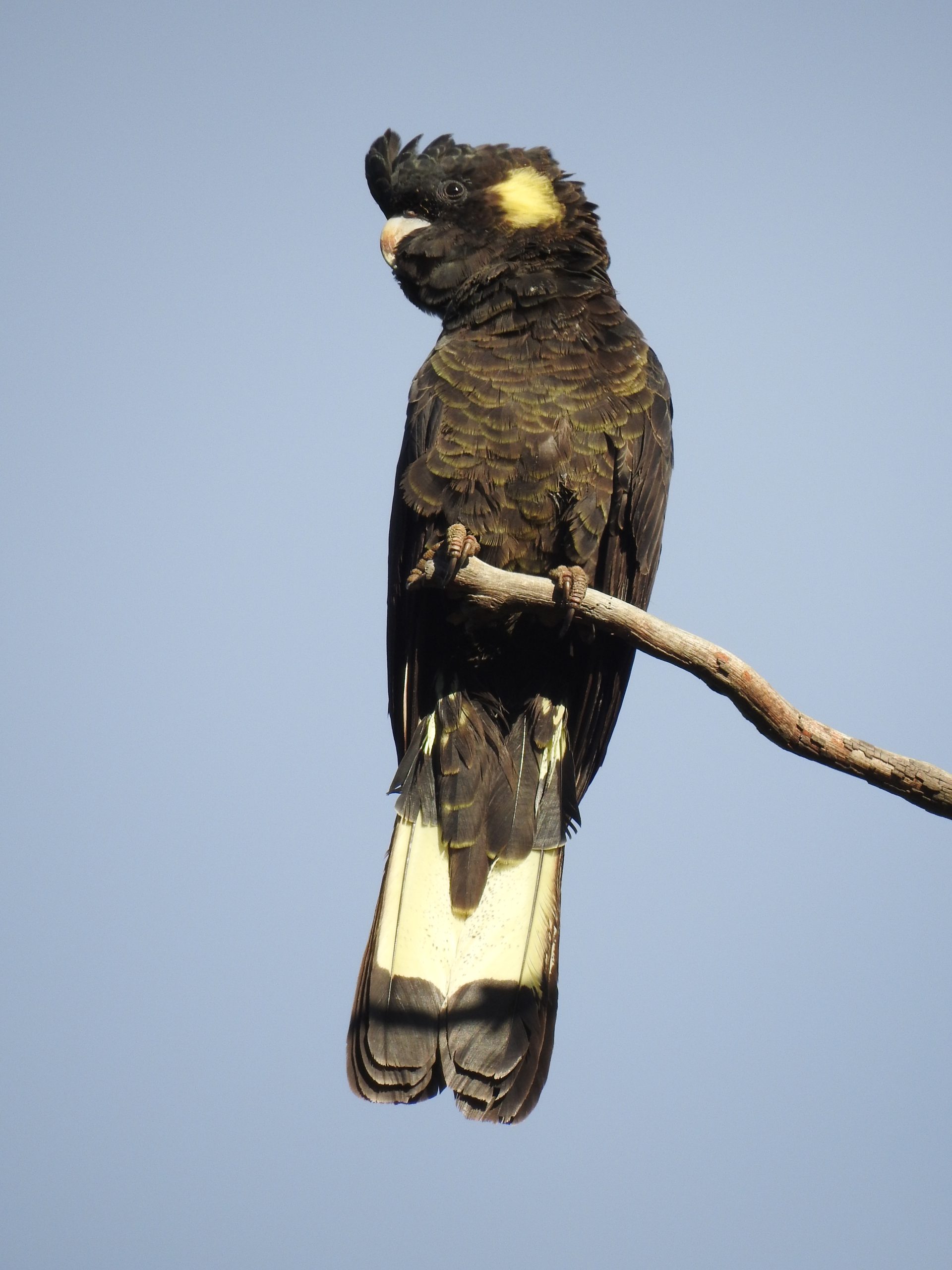
- Yellow Tailed Black Cockatoo
-
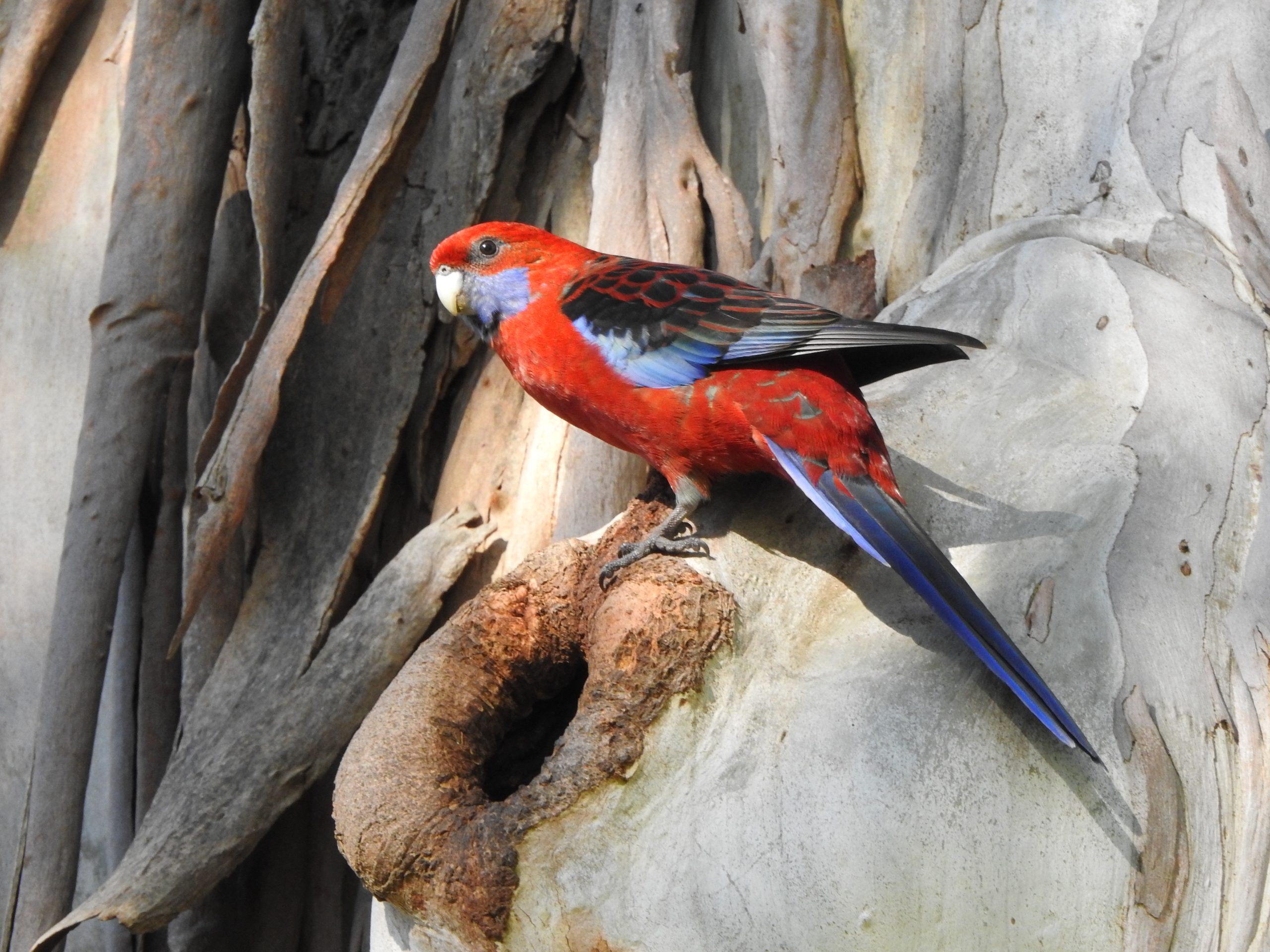
- Chrimson Rosella
Smaller bird species
Smaller bird species can also be seen from the walking track looking into Deadman’s Gully. Very occasionally a Kookaburra is still seen in the eucalypts near the start of the walking track and Sacred Kingfishers have been observed.
Various woodland birds that remain at the Mount include Thornbills, Honeyeaters, Grey Fantails, Red-browed Finches, Silvereyes, Grey Shrike-thrush, Fairy-Wrens, Pardalotes and Black-faced Cuckoo-Shrikes.
Frank Smith reported in 1909 that Cuckoo species were very common in Western Victoria. The Pallid Cuckoo, fan-tailed Cuckoo, Horsfield’s Bronze Cuckoo and Shining Bronze Cuckoo have traditionally swept down from the north in spring, timing their visits with the breeding season of their host species.
Robins are perhaps one of the most noticeable groups which are absent. Frank Smith described a visit to the Heytesbury Forest in 1913; “On every side there were robins, both flame-breasted and scarlet breasted, hundreds of them flitting amongst the trees like balls of fire”.
The mix of native birds residing at Mount Noorat and in the wider district continues to change as the range of different species expands or contracts. Crested Pigeons are likely the most recent example of a bird that has extended its range. Like the Galah it was once only a resident of the dry interior, but it is just about everywhere now, including the lower sections of Mount Noorat.